
- Aug 5, 2025
The Crisis We’re Not Talking About: Behavioral Health Deserts in Rural Minnesota
- Carmichael Finn
- 0 comments
I just returned from presenting at the 2025 MARATP Late Summer Conference, and one theme echoed loud and clear in nearly every conversation: rural Minnesota is struggling—badly—when it comes to meeting the behavioral health and substance use treatment needs of its residents. And we have the data to back it up.
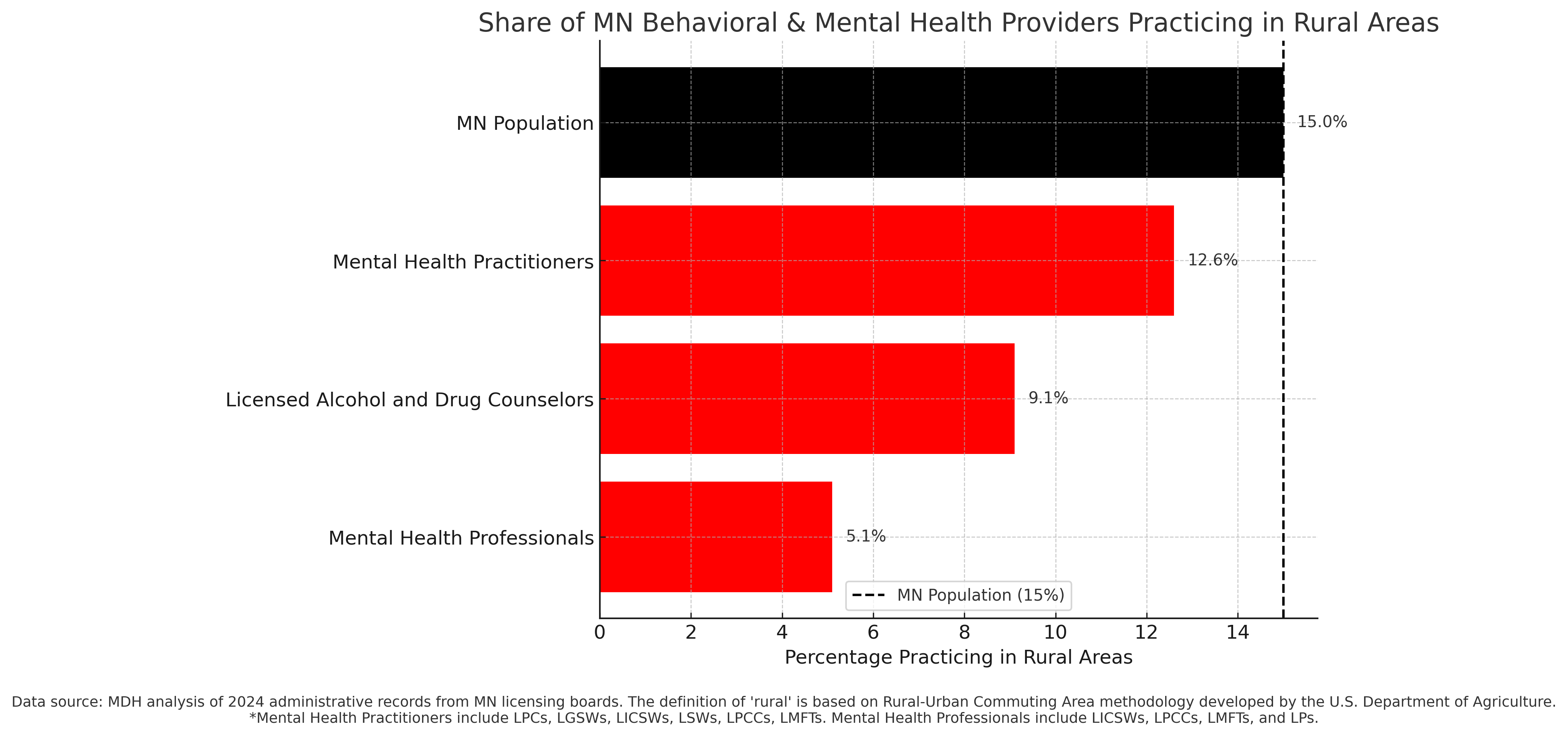
The graphic above, based on a 2024 analysis of Minnesota licensing records, shows the percentage of behavioral and mental health professionals practicing in rural areas. The black dotted line at 15% represents the percentage of Minnesotans who live in rural communities. So, ideally, you’d want to see each professional group meet or exceed that line.
But look at where our behavioral health workforce stands:
Mental Health Practitioners (LPCs, LMFTs, LICSWs, etc.): 12.6%
Licensed Alcohol and Drug Counselors (LADCs): 9.1%
Mental Health Professionals (LMFTs, LPCCs, LPs): 5.1%
These numbers reveal a stark maldistribution of essential providers—particularly in addiction treatment. The very people most in need of services are the least likely to access them due to geography.
Why This Matters — Even If You Don’t Work in Treatment
This isn’t just a "treatment center problem." It’s a ripple effect that touches every sector of society:
NICU and Emergency Room Overuse: Pregnant individuals with untreated SUDs are more likely to deliver babies requiring extended neonatal care. Many of these scenarios could be prevented with earlier behavioral health intervention.
Medicaid Strain: Preventable ER visits, untreated chronic conditions, and crisis-level interventions drive up public healthcare spending.
Child Welfare System: When rural families can’t access family-centered SUD care, we see more child removals, more trauma, and more long-term system involvement.
Criminal Justice System: Without access to outpatient or residential programs, rural clients often cycle through jails instead of getting help.
Economic Collapse in Small Towns: Workforce shortages in behavioral health contribute to the destabilization of local healthcare systems, schools, and social services.
If this doesn’t tug at your heartstrings, it should at least alarm your accountant. This problem is burning a hole in Minnesota’s pocketbook.
A Workforce on the Brink
Let’s be clear: this isn’t just about clients. This is also about the behavioral health workforce, which is exhausted, underpaid, and spread too thin. In rural areas, there may only be one or two LADCs or LPCCs serving a multi-county region. That’s not just a recipe for burnout—that’s a public health emergency.
And when we lose staff to burnout, we’re not just short a provider. We’re losing years of training, supervision, and clinical wisdom, and pushing the burden onto the few who remain.
What Needs to Change
We need:
Incentives to practice in rural areas: student loan forgiveness, relocation grants, housing stipends.
Telehealth infrastructure that truly supports rural clients—especially in areas where broadband is still unreliable.
Family-centered treatment models that keep children and parents together.
Cross-system collaboration across healthcare, child welfare, housing, and corrections to reduce duplication and create seamless referrals.
Most importantly, we need to invest in prevention and early intervention instead of waiting for people to fall apart.
Closing Thought
At MARATP, I saw hope. I saw passionate providers, leaders, and advocates who care deeply about this work. But we need to back that passion with policy—and funding. Because without it, rural Minnesota will continue to operate in crisis mode.
Behavioral health is not a luxury. It's infrastructure. It's the foundation that holds up families, communities, and economies. And until we address this rural workforce gap, we're all footing the bill.
Sources:
Minnesota Department of Health. (2025, August 5). ORHPC Monthly Update [Web post]. GovDelivery. https://content.govdelivery.com/accounts/MNMDH/bulletins/3e7e2ef
About the Author
Carmichael Finn, MA, LMFT, LADC, ADCR-MN is the Executive Director of Recovering Hope Treatment Center, a family-centered substance use disorder program in rural Minnesota. A licensed therapist, addiction counselor, educator, and advocate, Carmichael has spent his career fighting for ethical care, equitable access, and systemic reform. He serves on the Board of the Minnesota Certification Board and provides consultation, clinical supervision, and training across the state. Carmichael is passionate about rural behavioral health workforce development and ensuring that every Minnesotan—no matter their ZIP code—has access to quality care.